Review Essay of after Exhibition
By Rachael Parsons, Director
New England Regional Art Museum
At the conclusion of my first interview with criminologist and artist Rachel Dioso-Villa, I found myself googling “wrongful convictions, Australia.” It was a subject I realised I knew remarkably little about.
One of the first results I encountered was a list published by Sydney Criminal Lawyers outlining five of the most well-known Australian wrongful conviction cases. I recognised only one: the case of Lindy and Michael Chamberlain, a miscarriage of justice so deeply embedded within Australian cultural memory that the phrase “a dingo ate my baby” has long since flowed from tragedy into cliché.
This realisation of my own ignorance was unsettling. In Australia, wrongful convictions remain significantly under-recognised despite growing evidence that they occur with troubling regularity. Unlike the United States and United Kingdom, Australia has no formal national registry dedicated to documenting wrongful convictions or miscarriages of justice. Yet research conducted by Dioso-Villa has identified at least 71 known wrongful convictions in Australia between 1922 and 2015 alone, many resulting in years, and in some cases decades, of imprisonment before exoneration or release. These cases are not isolated anomalies, but evidence of systemic failures embedded within legal processes and institutional decision-making.
According to Dioso-Villa, recurring issues within the judicial process include mistaken identification, unreliable forensic evidence, assumed guilt, tunnel vision in police investigations, prosecutorial misconduct, and the misuse of expert testimony. These are terms most of us recognise through the familiar language of crime dramas and popular culture, absorbed through years of watching Law & Order. Yet they land very differently when attached to real lives, real imprisonment, and the irreversible consequences carried by innocent people and their families.
Importantly, these failures do not affect all people equally. Research into wrongful convictions in Australia and internationally has increasingly demonstrated that marginalised groups, particularly First Nations people, women, and people experiencing poverty, disability, or cognitive impairment, are disproportionately vulnerable within criminal justice systems. As the daughter of migrant parents, this disparity resonates deeply for Dioso-Villa, informing both the intellectual and emotional dimensions of her engagement with injustice.
It is within this context that Dioso-Villa’s exhibition After emerges. Developed alongside more than fifteen years of criminological research into wrongful convictions and miscarriages of justice, the exhibition considers not only the systemic nature of error within criminal justice systems, but also the personal and emotional impact of sustained engagement with injustice. Dioso-Villa takes on the role of artist, researcher, and activist, positioning creative practice as a form of both inquiry and intervention.
In doing so, After sits within a broader field of contemporary research-led and politically engaged art practices that use archives, text, repetition, and systems of display to interrogate structures of power. The exhibition’s text-based works recall the direct political language of Barbara Kruger and Jenny Holzer, while its engagement with evidence, institutional systems, and hidden infrastructures aligns with investigative and research-driven practices such as Forensic Architecture and Taryn Simon, whose work similarly explores the politics of classification, evidence, and institutional authority. Forensic Architecture in particular works within an interdisciplinary framework, operating across human rights, journalism, architecture, art and aesthetics, academia and the law to interrogate human rights violations, practices that directly correlates with Dioso-Villa’s creative process and conceptual focus. Within an Australian context, Dioso-Villa finds inspiration and resonates with First Nations’ artists including Judy Watson and Archie Moore, whose practices expose the exclusions and violences embedded within institutional systems and histories, communicated through visually arresting translations of data and historical research. In all cases, these artists’ practices are underpinned by deep conceptual rigour and extensive research. Like them, Dioso-Villa uses visual language not simply to represent injustice, but to interrogate and challenge the structures that allow it to persist.
While Dioso-Villa has maintained a visual art practice throughout her life, following a traumatic brain injury in 2021 drawing and painting became increasingly central to her work. What had once existed alongside her academic career evolved into a necessary mode of processing, reflection, and inquiry. During her recovery, art became both an outlet and a way of working through the emotional and psychological weight of the material she encountered daily through her research. It also emerged as an essential research tool: a means of translating data into visual form and developing new ways to comprehend, process, and communicate information beyond the limits of academic language.
This relationship between research, embodiment, and mark-making is particularly evident in the scroll works Between the Lines, 2026, where fragments of text and drawn imagery accumulate across delicate rice paper surfaces. Loosely informed by traditions of East Asian scholar scrolls, the works contain foreground research not as detached intellectual labour, but as a slow, physical, and deeply human process of absorbing and translating case materials, interviews and scholarly literature.
The interrogation of systems and institutional scale continues in What Can Be Counted, 2026, a sculptural installation responding to a recent Australian wrongful conviction in which an individual spent more than twenty years imprisoned before their release. Comprised of 410 identical white plastic figures organised by role, the work visualises the vast collective labour required to overturn a conviction once it has been legally fixed. Stripped of individual identity, the figures speak not to personal narrative but to systems, bureaucracy, and the immense infrastructure necessary to correct a single miscarriage of justice. At the same time, the work quietly acknowledges what remains uncounted: the emotional toll, invisible labour, lost years, fractured relationships, and forms of care that cannot be quantified or entered into official records. Data is impersonal, but it speaks to the very personal lived experiences of vulnerable and too often ignored people.
For Dioso-Villa, the relationship between criminology and art is not illustrative but deeply interconnected. Where academic writing demands evidence, structure, and restraint, art allows space for ambiguity, emotion, frustration, and moral outrage — “all the things I can’t say in an academic paper,” as she describes it. Her work emerges from years spent reading trial transcripts, examining forensic evidence, interviewing exonerees and their families, and confronting the repeated failures of legal systems that are meant to protect the innocent.
This tension between legal language and lived reality is powerfully distilled in the neon works Innocence Isn’t Enough and Actual Factual, 2026. Drawing directly from the terminology of post-conviction law, the works expose the unsettling logic through which innocence must not only exist, but be formally measurable, provable, and admissible within rigid legal frameworks, frameworks that often remain impenetrable to the convicted and largely out of sight, and out of mind, for the rest of us.
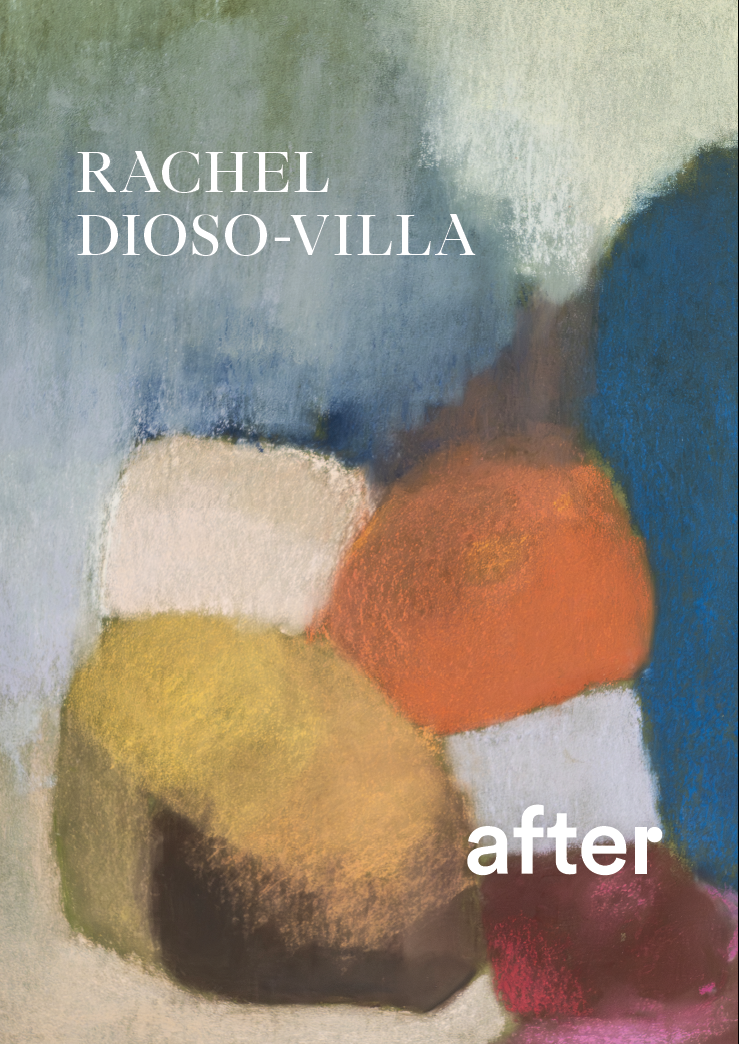
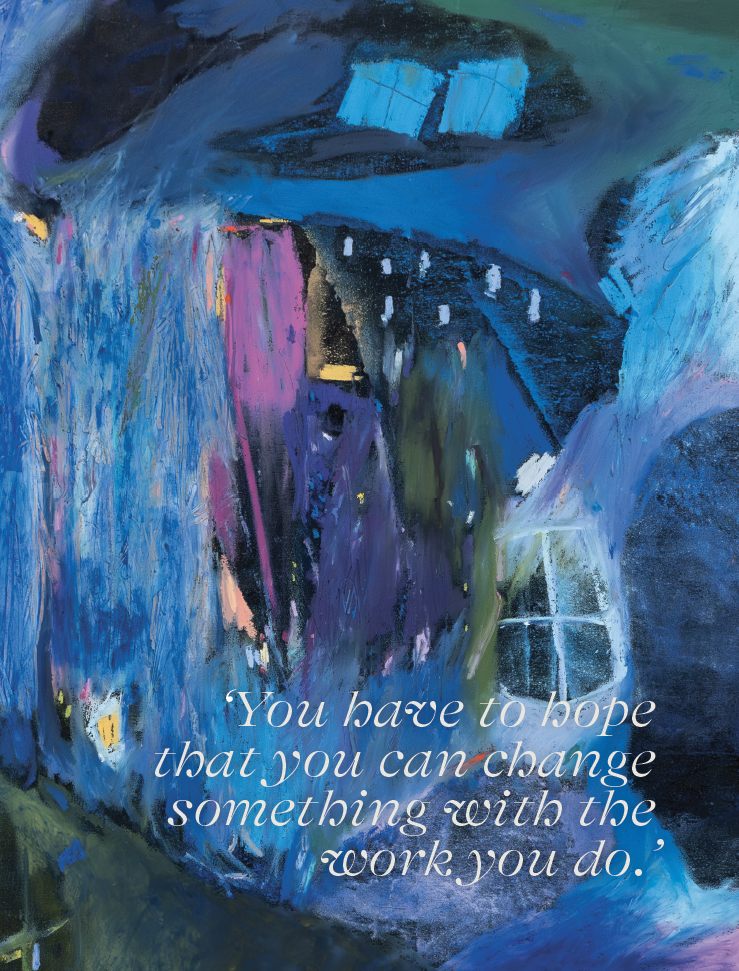
Importantly, Dioso-Villa does not position herself as speaking on behalf of those who have experienced wrongful conviction. Instead, her work reflects on what it means to work in close proximity to trauma and injustice over long periods of time. This concern with accumulation and emotional residue is particularly visible in the exhibition’s Uphill series, where dense, weighted forms push laboriously upward across the page. Created with soft pastel and watercolour crayon, the works evoke the often repetitive struggle involved in overturning a wrongful conviction, a process marked by resistance, delay, and the immense emotional labour required to pursue recognition and repair. Yet despite their conceptual weight, the works possess a striking softness and beauty. Their layered colour, tactile surfaces, and intuitive mark-making suggest something therapeutic within the act of making itself, offering moments of gentleness and care amidst material grounded in injustice and institutional failure.
Dioso-Villa is acutely aware of the role creative practice can play in sustaining mental health and resilience for those working in areas shaped by vicarious trauma. In this sense, the works function not only as acts of critique, but also of endurance and self-preservation, recalling the practice of Tracey Emin, who has long used art as a means of working through profound personal trauma. In both artists’ practices, deeply challenging subject matter is transformed into work that is intimate, vulnerable, and strikingly beautiful.
There is an underlying optimism within the exhibition, despite its difficult subject matter. Dioso-Villa speaks repeatedly about accountability, transparency, and the possibility of systemic change. Her research advocates for stronger safeguards within the legal system, including independent criminal case review commissions and greater support for incarcerated people seeking to challenge wrongful convictions. Yet After suggests that information alone is rarely enough. Art, for Dioso-Villa, becomes another way of translating and embodying knowledge and one capable of reaching audiences emotionally as well as intellectually. It provides a powerful platform for raising awareness of an issue that remains largely overlooked within public consciousness. And, as clichéd as it may sound, awareness and empathy are often the first steps towards meaningful action.
As Dioso-Villa reflects, “You have to hope that you can change something with the work you do.”